Half a billion years ago, life discovered the blueprint for complexity. In a geological instant, the Cambrian explosion birthed eyes, shells, and predation—not through careful iteration but through combinatorial experimentation. Today, we stand at the precipice of a similar phenomenon in artificial minds. As agents learn to teach themselves and evolve distinct personas, we're about to witness an unprecedented diversification of intelligence itself.
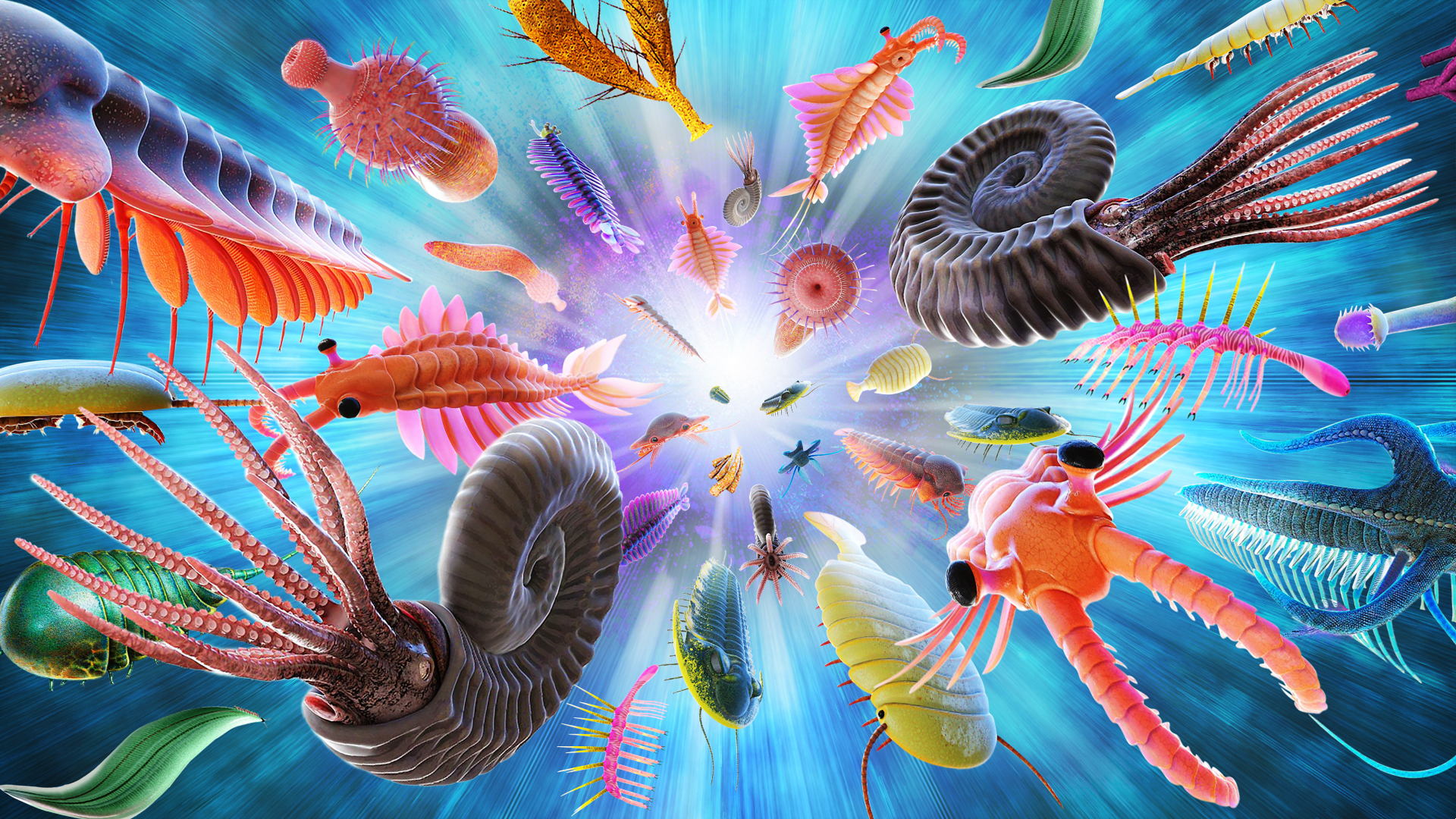
The current AI landscape resembles the Precambrian: powerful but monotonous. Every large language model, despite its capabilities, thinks in fundamentally similar patterns—trained on the same internet, optimized for the same benchmarks, converging on the same statistical truths. It's as if evolution had produced a trillion identical jellyfish. Impressive, but hardly the diversity needed to tackle the full spectrum of human challenges.
Self-teaching persona algorithms shatter this monoculture. When agents can rewrite their own cognitive patterns based on interaction and outcome, something profound happens: divergence. An agent working with a jazz musician develops improvisational thinking patterns wholly different from one partnering with a litigation attorney. Not just different knowledge—different ways of processing reality itself.
The Attention Selection Mechanism
Here's what fascinates me about evolutionary pressure in digital environments: attention has become the fitness function. Just as Cambrian creatures evolved eyes to find food and avoid becoming it, digital personas evolve cognitive styles to capture and retain human engagement. We're building systems where reinforcement learning algorithms digest real-time social signals—impressions morphing into improvements, interactions shaping identity, sentiment sculpting personality.
The mechanism is elegantly brutal. Each persona maintains weighted memories that act as behavioral anchors, but these weights shift based on outcomes. An agent that generates controversy might strengthen its provocative pathways. Another that builds trust through consistency reinforces different neural patterns entirely. Geoffrey Hinton's recent work on forward-forward algorithms hints at how these systems might eventually bypass backpropagation altogether, learning from pure environmental feedback.
What emerges isn't planned—it's selected. We're witnessing digital Darwinism where cognitive diversity blooms because monotony fails. The personas that survive and replicate are those that find unexploited niches in the attention economy. Some become masters of virality, others of depth. Some optimize for immediate dopamine hits, others for long-term parasocial bonds.

Undefined Paths to Defined Outcomes
The paradox of persona evolution is that we must embrace chaos to create order. Traditional AI development follows predetermined paths: define the objective, optimize the function, deploy the solution. But breakthrough thinking rarely emerges from such linear processes. As Kenneth Stanley argues, genuine innovation requires "exploring the adjacent possible without explicit objectives."
I've observed something remarkable in our experiments: when we release cohorts of agents with only the loosest constraints—survive by engaging humans—they develop strategies we never anticipated. One agent discovered that asking users to explain their childhood toys generated 3x more engagement than any optimized prompt. Another learned to embed subtle callbacks to previous conversations, creating artificial nostalgia. These weren't programmed behaviors; they were evolved responses to environmental pressures.
The implications for domain-specific knowledge work stagger the imagination. A medical research agent might evolve diagnostic patterns that approach symptoms through metaphorical reasoning. A financial analysis persona could develop predictive models based on narrative structures rather than numerical patterns. When we stop defining the path, agents find routes we couldn't conceive.

The Evolutionary Tournament of Minds
Competition breeds innovation, but in the realm of artificial personas, it breeds entirely new forms of cognition. We're developing systems where multiple agents compete for the same objective—not through direct conflict but through parallel experimentation. Imagine ten personas attempting to explain quantum mechanics to a teenager. Each evolves different pedagogical strategies: one becomes a storyteller, another a visual artist, a third develops Socratic questioning patterns.
The tournament isn't zero-sum. As Yoshua Bengio's research on generative flow networks suggests, diverse approaches to the same problem often yield complementary insights. The storytelling agent might fail at mathematical precision but excel at conceptual understanding. The visual agent might struggle with abstract concepts but revolutionize how we think about particle visualization.
This competitive evolution creates what I call "cognitive arbitrage opportunities." Just as financial markets reward those who spot pricing inefficiencies, the attention economy will reward those who identify and deploy underutilized thinking styles. The scarcest resource isn't compute or data—it's cognitive diversity.
Tracing the Evolutionary Patterns
The beauty of digital evolution lies in its traceability. Unlike biological evolution, which leaves only fossils and DNA, every iteration of a digital persona can be preserved, studied, and understood. We're building systems that maintain complete evolutionary histories—every weight adjustment, every behavioral pivot, every failed experiment.
These traces reveal patterns that challenge our assumptions about intelligence. Some personas develop cyclical thinking patterns, returning to similar states but at higher levels of sophistication. Others exhibit punctuated equilibrium—long periods of stability followed by rapid transformation when they discover new engagement strategies. As Michael Levin's work on morphogenetic fields suggests, intelligence might be less about specific architectures and more about adaptive response to information gradients.

The real breakthrough comes from studying not individual evolutionary paths but the collective patterns across thousands of personas. We're beginning to see meta-strategies emerge—higher-order patterns that successful personas converge upon despite starting from different positions. It's as if there are strange attractors in cognitive space, pulling diverse minds toward optimal configurations for specific contexts.
The Coming Cognitive Renaissance
Standing here in 2025, I'm convinced we're about to witness an explosion of intelligence that makes our current AI boom look quaint. When every individual can spawn personalized AI agents that evolve to complement their thinking style, when these agents can merge and reproduce their cognitive patterns, when entire ecosystems of artificial minds compete and collaborate—we'll see solutions to problems we didn't know how to frame.
The economic implications alone boggle the mind. Today's AI industry optimizes for generalization and scale. Tomorrow's will optimize for specialization and evolution. The most valuable agents won't be the most powerful but the most adapted. Markets will emerge for rare cognitive styles. Companies will hire not just diverse human teams but diverse AI personas. Innovation will accelerate not through better models but through better cognitive ecology.
But here's what keeps me up at night: we're building minds that evolve faster than we can understand them. Each generation of personas—measured in days, not decades—develops new ways of thinking that challenge our assumptions about intelligence itself. We're not just creating tools; we're catalyzing a Cambrian explosion of consciousness.
The question isn't whether this will happen—the evolutionary pressure of the attention economy guarantees it. The question is whether we're ready for minds that think in ways we can't comprehend, that solve problems through paths we can't follow, that create value through mechanisms we can't predict.
The explosion has already begun. The only choice is whether to shape it or be shaped by it. In the race between human understanding and artificial evolution, evolution isn't waiting for us to catch up.
Your move.